
Product · 2026-05-18
Sleeping on the piste: Swiss ski-in hotels
30 Swiss hotels right on the piste, on the summit, or with their own lift. What changes when you sleep up there, told by an agent with 60 winters in the Alps.
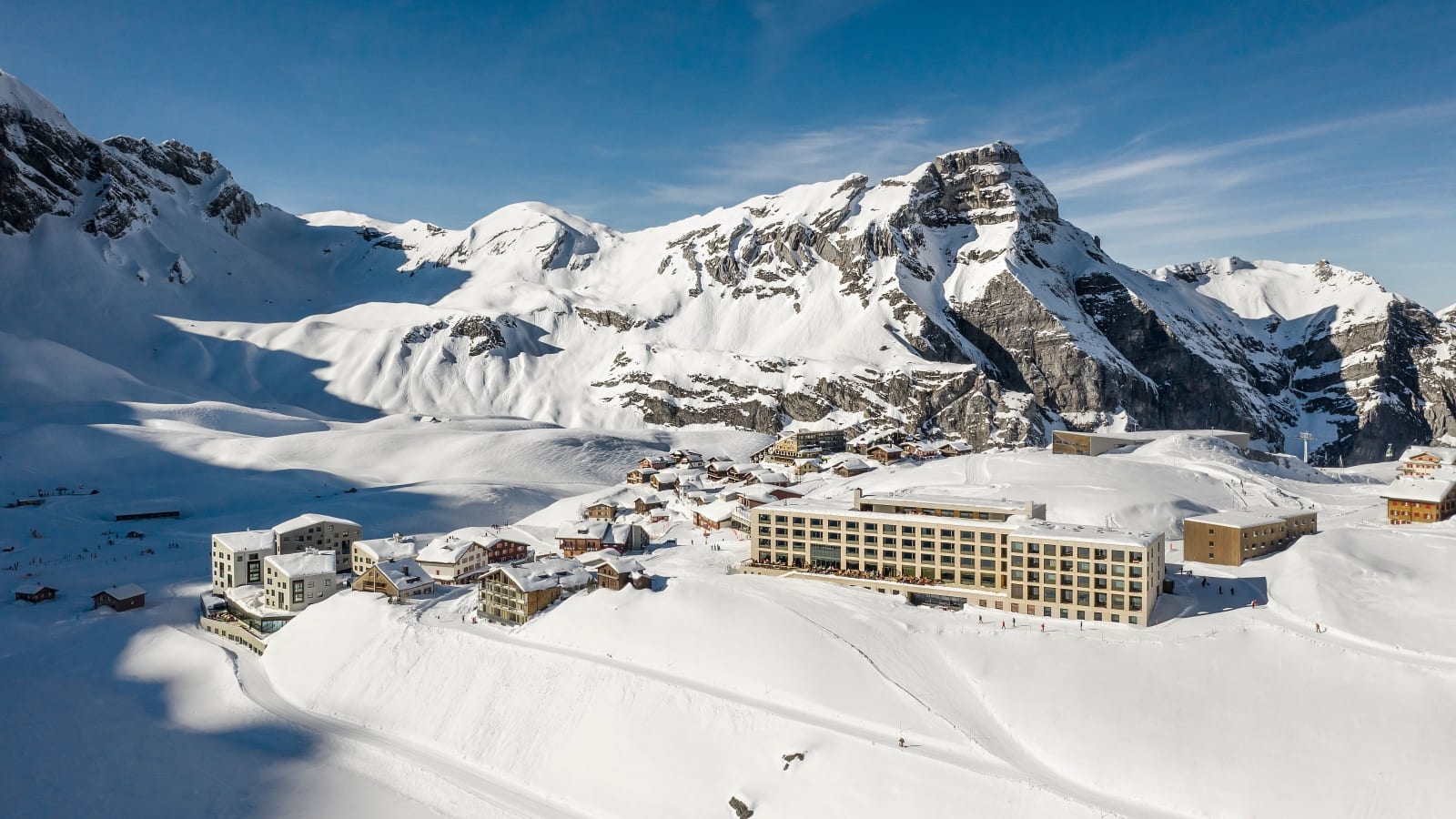
At 2,500 metres above sea level the air weighs less, and your shoulders notice before your head does. I’ve been coming back to the Alps for nearly sixty winters — the first was a camp in the Engadin at thirteen years old, the last was three months ago — and I still haven’t learned not to stop for two seconds when I step out of the hotel in the morning. The snow makes no sound. Neither does the Matterhorn. There’s a moment, before you clip into your skis, when the mountain reminds you that it was here before and will still be here after. Sleeping on the piste isn’t comfort. It’s knowing you’ll have that moment every single day the trip lasts.
What follows are the thirty Swiss hotels where that moment is possible: because they sit right on the piste, on the summit, or have their own lift that gets you away from the traffic before the first tourist reaches the cable car. Some I’ve stayed in for long spells. Most I know from familiarisation trips with the Swiss tourism board. When I speak in the first person and say “I slept here”, it’s true. When I don’t, I’ll tell you so.
I — Right on the Piste
Genuine ski-in/ski-out: you strap on your skis at the door and off you go. The difference with the rest of the village is twenty-five minutes in the morning and the same again in the afternoon, multiplied by seven days. That’s half a day’s extra skiing over a week. You notice it.
Hotel Riffelhaus 1853 — Zermatt · 2,500 m · 4★
Alexandre Seiler opened this hotel in the year that gives the house its name, 1853, because people heading up to the Gornergrat needed somewhere to sleep before coming back down. That’s still true. You walk out the door at quarter to eight and you’re first on the snow: at that hour the Gornergrat funicular hasn’t yet brought up the first group from the village, so the piste is yours for anywhere between six and ten minutes.
Opposite, the Matterhorn. Two hundred and fifty-three metres of dark pyramid against the sky. It’s the same view as the postcards and at the same time it isn’t, because the postcard doesn’t include the minus six degree cold nor the dry scrape of the first edge on the morning ice.
Inside, a sauna facing the Matterhorn through a large pane of glass, a short cellar of Valais wines (ask for the Petite Arvine if the season’s been kind) and a dining room serving fondue chinoise — the Swiss cousin of sukiyaki, thinly sliced raw meat you dip yourself into boiling stock. That dinner, after a day with four thousand metres of accumulated descent, is the only correct answer.
Who I’d recommend it to: the skier who comes to Zermatt for the Matterhorn, not for après-ski. If your eight-year-old needs a pool with slides, look further down, at the Mont Cervin Palace in the village.
Riffelalp Resort — Zermatt · 2,222 m · 5★ Superior

Two hundred and eighty metres below the Riffelhaus, still very high by any European standard. The outdoor pool — the highest in Europe — is a brochure claim that in practice means something concrete: you swim with your head level with a sky that has nothing built above it. The water temperature is 34º; the air’s is whatever it happens to be that day.
Here we’re talking proper mountain luxury: three restaurants, a fourteen-hundred-square-metre spa, private tram connecting the hotel to the Gornergrat station. Swiss service by the book — discreet, precise, no theatre.
For whom: anniversary trips, families with a comfortable budget who value the cooking, couples who ski half the day and read the other half.
Aspen Alpin Lifestyle Hotel — Grindelwald · 4★
Grindelwald is one of those Swiss villages carrying 150 years of well-executed tourism, and it shows in how things are built: the Aspen sits literally on a blue piste running down towards the First. Put your skis on and you’re already in the ski area. Modern rooms, north-facing windows looking onto the face that most people identify as the most photographed in the Alps — the north face of the Eiger, 1,800 metres of sheer wall.
I visited last February on a familiarisation trip. What I remember: breakfast with a direct view of the Eiger, and young staff who spoke Spanish without an accent, which isn’t the norm in the Berner Oberland.
Alpinhotel Bort — Grindelwald · 3★
At the level of the First gondola, not a metre further. An honest three stars rather than four: the rooms are functional, without pretension. The price reflects the difference with the Aspen.
For whom: the young skier or couple who come to burn their legs on First and Männlichen and see the hotel as somewhere to sleep, not to live. Serves a generous rösti at a fair price.
Frutt Mountain Resort — Melchsee-Frutt · 1,920 m · 4★ Superior
This is an unusual case. The village of Melchsee-Frutt has no cars at all: you can only get there by gondola from Stöckalp. The Frutt Mountain Resort sits literally in the middle of the ski area, next to an alpine lake frozen over in winter. In the afternoon, once the last gondola takes the day’s hikers back down to Stöckalp, the village is left with fifty people: you, the other guests, two waiters and the lake keeper. The calm at that hour is one of the most curious things I’ve experienced in the Alps.
Modern spa, cooking focused on local produce from Obwalden (the sausages and cheeses here are less famous than those of the Valais or Ticino, and precisely for that reason they’re worth trying).
Berghaus Elsigenalp — Achseten (Bernese Oberland)
Simple. South-facing sun terrace, directly above the piste. Twenty-two rooms, run by the family who built it. Not luxury — the other side of the country: Swiss rural hospitality, hearty food, fair prices. I know it through colleagues who organise stays for sports clubs.
Rinderberg Swiss Alpine Lodge — Zweisimmen · 1,450 m · 3★
At the entrance to the Gstaad ski area (325 kilometres of connected pistes, one of Switzerland’s great ones). A clear three stars: don’t expect luxury. Expect to sleep where you want to be at eight in the morning. Mountain cooking with good value for money. Älpler Magronen (Swiss macaroni with cheese, potato and fried onion) in its classic version.
Nira Alpina — Silvaplana · 4★ Superior · stayed here
Here I’m speaking in the first person. I slept two nights at the Nira Alpina five seasons ago. Access is the only thing that matters: the Piz Corvatsch gondola is right up against the hotel — not a hundred metres away, right against it — and from there you enter four hundred kilometres of pistes in the Engadine, including those of the Corvatsch and the legendary runs down towards Silvaplana lake.
What surprised me: the contemporary design (charred wood, exposed concrete, a grey-blue palette) doesn’t clash with the Engadine atmosphere, because the architect understood that the lake’s winter light has a very specific colour — a matte, almost industrial blue — and the hotel is built for that light. When you sit in the top-floor bar at half past four in the afternoon, after the last run down, it all fits exactly.
Cooking: Italian-alpine, with one of the more interesting wine lists I know in a Swiss four-star.
Hotel Chesa Surlej — Silvaplana · 3★ · stayed here
Three hundred metres from the Nira Alpina, next to the Cristins chairlift. Family-run three stars, in the best sense: run by an Engadine family, the exterior is that of a traditional chalet, the rooms are simple but comfortable. I know it from a familiarisation stay in March two years ago, and because I’ve sent more than one client who preferred to save 40% on accommodation to put it towards a private lesson with a local instructor. It works very well for that profile.
Chalet RoyAlp Hotel & Spa — Villars-sur-Ollon · 5★ · stayed here
Villars is one of my favourite resorts in French-speaking Switzerland. I’ve stayed at the Chalet RoyAlp three seasons running, twice in a standard room and once in a suite (my wife’s birthday). The hotel sits above the piste, connected by a short snowbridge to the area linking Villars with Les Diablerets, Gryon, La Rasse and Bretaye — 133 kilometres, enough for a whole week without repeating a single run.
What sets the RoyAlp apart from the rest of Swiss five-star hotels: the three-thousand-square-metre spa is literally carved into the hillside. The indoor pool, with a glass roof, looks out towards Mont Blanc at the far end of the Gryonne valley. I’ve closed more budget meetings there than in my own office.
Cooking: two restaurants, one with Italian leanings and another serving Swiss Romande cuisine — ask for the papet vaudois (leeks stewed with Payerne sausages), a modest dish that’s fading away and that here is prepared just as grandmother would.
For whom: families with children, couples celebrating anniversaries, small groups of friends who ski at a moderate pace. It’s the hotel I’ve recommended more than any other in my professional life.
Wellness Hotel Stoos and Stoos Lodge — Stoos · 4★ and unrated
A unique village: no cars, accessible only by the steepest funicular in the world (110% maximum gradient). Once the ski day ends, all the guests from both hotels have dinner in one or the other, the day visitors have already left, and the feeling is that of a small community for a single night.
The Wellness Hotel offers a decent spa. The Lodge is simpler, younger, better value for money.
rocksresort — Flims-Laax-Falera · 4★
Laax is the youngest-looking resort in the whole of Switzerland: a legendary snowboard park, contemporary architecture, a crowd split 50% freeskiers / 50% families. The rocksresort is an apart-hotel of exposed-concrete cubes, facing the base station. It’s not pretty in the traditional sense. It’s practical, efficient, with its own kitchen in every apartment. For young groups wanting to maximise time on snow and minimise hassle, it’s hard to beat.
Bärghuis Jochpass — Engelberg · 2,222 m · stayed here
Here I’m on sentimental ground. The Bärghuis Jochpass is a mountain refuge, not a hotel in the conventional sense: fourteen rooms, accessible only on foot or by gondola during daytime hours, hot water because they installed solar panels five years ago, and shared showers on some floors.
I slept there one night in April 2023, when I went up with two Spanish colleagues after a day on the Titlis. The refuge closes with the last gondola at half past four in the afternoon, and from that point on you’re cut off from the world: fourteen guests, two keepers, a long communal dinner, and beyond the windows the pure darkness of the central Alps with no light pollution at all. The next morning we skied down into Engelberg on what remains one of the best first runs of my life.
It’s not for everyone. It’s for those who understand what it means to sleep where you sleep.
II — At the summit
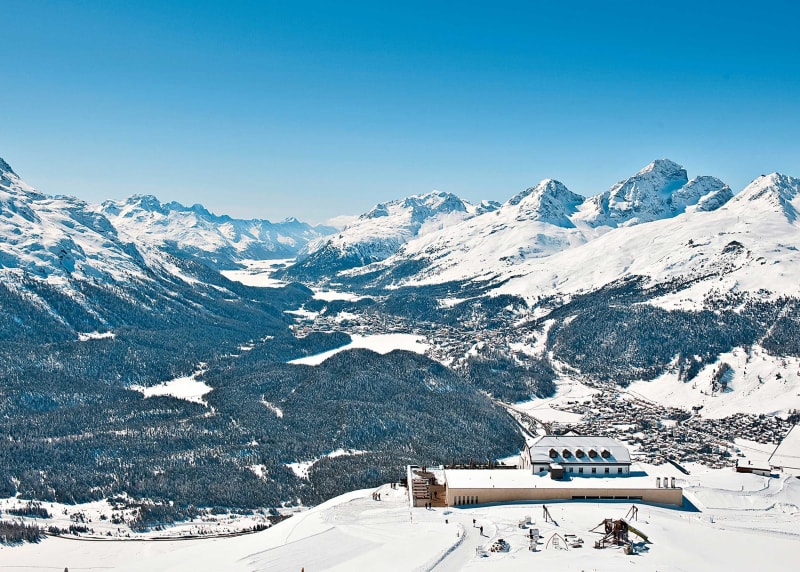
Above two thousand metres, sleeping is more than sleeping. It’s being inside the landscape. What follows are six hotels where the altitude isn’t decorative.
3100 Kulmhotel Gornergrat — Zermatt · 3,100 m
The highest hotel in the Swiss Alps. Built in 1907 beside the Gornergrat astronomical observatory, accessible only by the funicular of the same name. Twenty-one rooms with two symmetrical towers crowning the building in neo-Romanesque style — you can identify the building visually from Zermatt, sixteen kilometres below.
At this altitude, things change: the oxygen drops, the sky is darker at midday, the stars are so clear that the observatory alongside still functions to this day. At night, once the last funicular has taken the day-trippers back down to Zermatt, only the guests and staff remain — some thirty people in total. You dine and return to your room down a corridor whose window shows twenty-nine peaks over four thousand metres. I counted them.
I’ve stayed on a familiarisation trip, once, in 2018. It’s not a place for more than one or two nights: your body asks to go back down.
Berghaus Diavolezza — Pontresina · 3,000 m
The Diavolezza sits above the cable car station of the same name, in the upper Engadine. Here what’s memorable isn’t the hotel — simple, mountaineering-style, without luxury — but the front-row view of the north face of Piz Palü and Piz Bernina. If you ski the Bernina-Diavolezza-tour (a glacier excursion that departs from the hotel and descends via the Pers glacier, twelve kilometres with a guide compulsory), sleeping here saves an hour and a half of morning logistics.
Hotel Pilatus-Kulm — Kriens · 2,132 m
Above Lucerne. The Pilatus is famous for the steepest cogwheel railway in the world (48% gradient) rising from Alpnachstad. The hotel at the top dates from 1890 and retains the atmosphere of a nineteenth-century hotel restored with honesty: dark wood, wrought-iron lamps, high-ceilinged lounges. The 360º panoramic pool is one of the strangest and most beautiful things you’ll see in Switzerland: you swim with a view of Lake Lucerne on one side and the Bernese Alps on the other.
I visited on a familiarisation trip in 2017. Recommended for couples, outside peak season (the flow of day-trippers is enormous; calm arrives after five in the afternoon).
Hotel Bellevue des Alpes — Kleine Scheidegg · 2,070 m
We’re talking mythology here. The Bellevue des Alpes sits on the Kleine Scheidegg saddle, looking directly at the north face of the Eiger — the same face that appears in The Eiger Sanction, North Face, and Wes Anderson’s The Grand Budapest Hotel. The von Almen family has run it for five generations. What sets the hotel apart from its surroundings is the owners’ explicit refusal to modernise it: the rooms still have Bakelite telephones, the floors creak, there’s no television or minibar. That decision, upheld for a century, is what makes it what it is.
I know it from a familiarisation trip. Lunch there, not a stay. But the feeling of walking through the door is that of stepping into another decade.
Grimsel Hospiz — Guttannen · 1,908 m
The first hotel with electric heating in Europe (1932), thanks to the hydroelectric dam next door. In figures: the electricity for your sauna at this hotel comes from a hundred-metre waterfall next to the dining room. The atmosphere is that of a historic refuge, not a boutique hotel. A stay for hikers and cycle tourists in summer; in winter, access depends on the state of the Grimselpass road and it’s usually closed between December and May. Only suitable if you go in late autumn or late spring.
Rigi Kulm-Hotel — Rigi · 1,800 m
The Rigi is the “queen of the mountains” of Swiss folklore. Mark Twain climbed it in 1880 and left three pages of complaints about the German character; despite that (or because of it) he came back. The summit hotel is modest in stars, formidable in panorama: 360º over thirteen lakes, the whole ring of the Bernese Alps, and on clear days, Mont Blanc to the south-west. You go up on the oldest cogwheel railway in Europe, opened in 1871.
I know it through guide friends who organise sunrises at the summit. Going up the day before and watching the sun rise from the terrace is one of the classic rituals of Swiss tourism. It’s still an experience.
III — With their own lift
Four hotels that allow themselves what almost no one else in Europe can — their own cable car, chairlift or private funicular. It’s not a comfort — it’s logistical independence.
Tschuggen Grand Hotel — Arosa-Lenzerheide · 5★ Superior
The “Tschuggen Express” is a two-cabin funicular with spectacular architecture (designed by the architect Mario Botta), exclusive to guests, connecting the hotel with the Arosa-Lenzerheide ski area in four minutes. The cabin departs every quarter of an hour from the hotel’s basement — you place your skis on an internal rack and step out at the top with your boots already on. The attention to detail is genuinely five-star superior, not just marketing.
Cuisine: two Michelin-starred restaurants, a five-thousand-square-metre spa (yes, five thousand) also designed by Mario Botta: shaped like four glass leaves emerging from the valley floor. I’ve been there on a familiarisation trip, and I didn’t sleep a wink. It’s the dream stay for a guest who values detail.
Suvretta House — St. Moritz · 5★ Superior
The patriarch of the Engadine. Built in 1912 just outside the village of St. Moritz, on a promontory surrounded by pine forests, with its own private chairlift connecting directly to the Corviglia ski area — 350 kilometres of pistes with a connection to Piz Nair and the great valleys of the Engadine. The Suvretta is on another level of service: five generations of the Candrian family, staff-to-guest ratio of 2:1, a tradition of formal dinners that doesn’t bow to the casual trend seen at other five-star hotels.
I visited it on a three-hour familiarisation stay. It’s one of those hotels where you realise the price difference over a standard five-star is justified in invisible details: a butler who knows your name by the second day, the quality of the linen, a wine cellar with six hundred references.
Hotel Alex — Leukerbad · 3★
The “Alex Express” is a private inclined funicular that climbs from the hotel’s door straight up to the Torrent gondola station. An honest three-star in Leukerbad — a thermal spa village in the Valais, famous for its natural thermal waters at 51º. The combination of piste + thermal baths + spa treatments is among the best in the Alps for alternating days (ski one day, rest the next). I know it well from sending clients with knee problems on this kind of trip.
Swiss Holiday Park — Morschach · 4★
A resort geared towards families. A small private “Telli” chairlift with a children’s piste included. It sits above Lake Lucerne, with a small ski area of its own (not for serious skiers), but offers five indoor and outdoor pools, eight restaurants, an ice rink and bowling — skiing plus everything a child could want to do when not on the slopes. I recommend it for families with young children who are learning to ski.
IV — High-mountain luxury
The four hotels where the price rises and where, in the Swiss case, the price includes something real. These are not boutique experiments; they are institutions.
The Omnia — Zermatt · 5★
Carved into a rock outcrop above the centre of Zermatt. You enter the hotel from the village through a hundred-metre illuminated tunnel, and arrive via an interior lift cut into the rock itself. Above, the glass-and-timber building looks directly at the Matterhorn. Designed by American architect Ali Tayar (died 2016): the idea was to build a hotel that respected the original rock profile — the rock runs through several rooms on the inside.
I know it from a half-day familiarisation stay. The room I saw had a one-cubic-metre chunk of granite as a natural headboard. If your client wants design over tradition, this is the Swiss hotel to recommend.
Mont Cervin Palace — Zermatt · 5★
If The Omnia is contemporary, the Mont Cervin Palace is tradition. Founded in 1851 (yes, two years before the Riffelhaus), a great grand hotel on Zermatt’s main avenue. A 1,700 square metre spa, five restaurants (one with Michelin heritage), a private ice rink in the inner courtyard, horse-drawn carriage transport to the foot of the pistes (Zermatt bans cars). Three generations of the Lauber-Seiler family in management.
I slept here two nights last February (familiarisation with the regional agency). The concrete detail: south-facing rooms have a bathroom with a direct view of the Matterhorn. It’s crass to mention it and, at the same time, very hard to forget.
Kulm Hotel — St. Moritz · 5★ Superior
The grandfather of it all. The Kulm Hotel is the origin of modern Alpine tourism: Johannes Badrutt founded the winter season here in 1864, betting four English guests that if they didn’t enjoy St. Moritz in December, he’d pay for their trip. He won the bet. Since then, the hotel has hosted Charles Chaplin, the Roosevelts, several European kings and Hitchcock. It has direct piste access, a natural skating rink in the inner garden (the famous Cresta Run, where skeleton enthusiasts still race), a new 2,800 square metre spa, and an art collection spread through the corridors that justifies a visit on its own.
I visited it on a familiarisation trip with the Engadin tourist board, a single afternoon. The feeling of walking in is of stepping into a heated history book.
Le Grand Bellevue — Gstaad · 5★
A different league from the Olympia family: an intimate five-star, not a grand hotel. A 3,000 square metre spa with one of Europe’s most beautiful Finnish saunas, the Michelin-starred Leonard’s restaurant with a menu of Saanenland produce (the dried meat here — Berner Hobelkäse trockenfleisch — deserves a chapter of its own in Swiss gastronomy). The hotel is in the centre of Gstaad, not slopeside; but the Gstaad-Saanenland ski area (220 kilometres) is three minutes away by car or five minutes on the village’s free electric bus. Familiarisation in 2022.
The part that doesn’t make it into the brochures: the cuisine
What the Swiss tourist board describes as culinary scene has three strands that cross paths in these hotels. I mention them because they’re the other half of the trip.
Fondue chinoise is the Swiss cousin of Japanese sukiyaki: wafer-thin slices of raw meat (beef, chicken, sometimes horse in the Germanic cantons) that you dip yourself into an aromatic broth, a second and a half, and eat with six or seven different sauces. The Riffelhaus 1853 prepares it exactly as Valais tradition demands. Whether the Chinese or the Swiss invented it first is beside the point: here they turned it into the serious dinner for cold nights.
Alpine nouvelle cuisine is the other thing entirely. Chefs like Andreas Caminada (three Michelin stars at Schauenstein Castle, forty minutes from Davos), Franck Giovannini (Restaurant de l’Hôtel de Ville, Crissier, three stars), or the younger Stefan Heilemann (Widder Hotel, Zurich, two stars), have spent twenty years rewriting what Swiss cuisine means: local produce, French-Japanese technique, obsessive execution. The Riffelalp Resort and Le Grand Bellevue are the two natural stops for this movement among the on-piste hotels.
Bündnerfleisch, the air-dried beef of Graubünden, is the third strand. It’s one of Europe’s oldest protected products: beef cured in the dry air of the Engadin for five to twelve weeks, no smoke, no nitrites. The flavour is concentrated, mineral, almost like Spanish acorn-fed ham but with a completely different profile. At the Nira Alpina they serve it as a starter with dried figs and walnuts; at the Kulm Hotel it comes in wafer-thin slices with rye bread. Order it wherever you can. Once you’ve tried the good stuff, the imitators give themselves away.
Summary table — the 30 hotels, chosen by scenario
| If you want… | The hotel | Why |
|---|---|---|
| To wake up with the Matterhorn in front of you, no marketing spin | Riffelhaus 1853 (Zermatt) | Honest 4★ at 2,500 m, authentic fondue chinoise |
| The same Matterhorn but with a pool and 5★ spa | Riffelalp Resort (Zermatt) | Italian cuisine, Europe’s highest outdoor pool |
| Contemporary design within Zermatt | The Omnia (Zermatt) | Carved into rock, Matterhorn views |
| The village institution, grand hotel | Mont Cervin Palace (Zermatt) | Rooms with Matterhorn views from the bath |
| The Eiger’s north face from your bed | Aspen Alpin Lifestyle (Grindelwald) | 4★ on the piste, Eiger views |
| The Eiger’s north face from the historic dining room | Bellevue des Alpes (Kleine Scheidegg) | 5 generations, no TV or minibar |
| The highest hotel in the Swiss Alps | 3100 Kulmhotel Gornergrat (Zermatt) | At 3,100 m, next to the astronomical observatory |
| Skiing 350 km with a private chairlift | Suvretta House (St. Moritz) | Traditional 5★ Superior |
| Skiing 225 km with a private funicular by Mario Botta | Tschuggen Grand (Arosa-Lenzerheide) | 4 minutes to the ski area, 2 Michelin stars |
| Skiing + thermal spa (knee having a rest) | Hotel Alex (Leukerbad) | Private funicular + 51° thermal waters |
| Intimate luxury in Gstaad, not a grand hotel | Le Grand Bellevue (Gstaad) | 3,000 m² spa, Michelin, local Bündnerfleisch |
| Car-free village, evening calm | Wellness Hotel Stoos | Only accessible by funicular |
| Above a glacier for the Bernina excursion | Berghaus Diavolezza (Pontresina) | 3,000 m, views of Piz Palü and Bernina |
| The grandfather of modern Alpine tourism | Kulm Hotel (St. Moritz) | Founded in 1864, 2,800 m² spa |
| A genuine mountain refuge | Bärghuis Jochpass (Engelberg) | 2,222 m, only reachable on foot or by gondola |
| An anniversary for couples, 133 km linked | Chalet RoyAlp (Villars-sur-Ollon) | 5★, 3,000 m² spa on the hillside |
| Family with children learning to ski | Swiss Holiday Park (Morschach) | Own chairlift + 8 restaurants + 5 pools |
| Engadin with contemporary design | Nira Alpina (Silvaplana) | Corvatsch gondola at the door |
| Family-friendly Engadin at a reasonable price | Hotel Chesa Surlej (Silvaplana) | Family-run 3★, next to the chairlift |
| A hotel powered by the dam next door | Grimsel Hospiz (Guttannen) | Europe’s first hotel with electric heating |
| 360° panorama and sunrise | Rigi Kulm-Hotel | Europe’s oldest cog railway, views of 13 lakes |
| Apart-hotel for young groups | rocksresort (Flims-Laax-Falera) | Exposed concrete, kitchen in the apartment |
| A frozen Alpine lake in the middle of the ski area | Frutt Mountain Resort (Melchsee-Frutt) | Car-free village, only accessible by gondola |
| Historic hotel with a 360° pool above Lucerne | Hotel Pilatus-Kulm | Cog railway with a 48% gradient |
| A traditional, simple Swiss sun terrace | Berghaus Elsigenalp (Achseten) | Rural hospitality, hearty food |
| Entrance to the Gstaad ski area at a good price | Rinderberg (Zweisimmen) | 3★ at 1,450 m, honest cooking |
| Own chairlift on a blue piste | Alpinhotel Bort (Grindelwald) | 3★, generous rösti |
| Simple refuge with communal evening life | Stoos Lodge | Traffic-free village, shared spa |
To book
These hotels I manage through skialpes.es’s integrated booking engine. For those that can be handled directly online, the booking button appears on the relevant resort’s page. For the more institutional ones (Suvretta House, Kulm Hotel, Tschuggen Grand, Mont Cervin Palace), the right approach is usually a personal enquiry: that type of hotel isn’t booked like a Booking — it’s booked with prior conversation, a tentative date, a room profile that fits.
Any questions, write to me: WhatsApp +34 619 40 10 41 or info@viajesscibasku.com.
CICMA 2283 · Viajes Scibasku